SSD vs NVMe: Understanding the Key Differences for Your Hosting Needs
Print- 0
SSD vs NVMe: Understanding the Key Differences for Your Hosting Needs
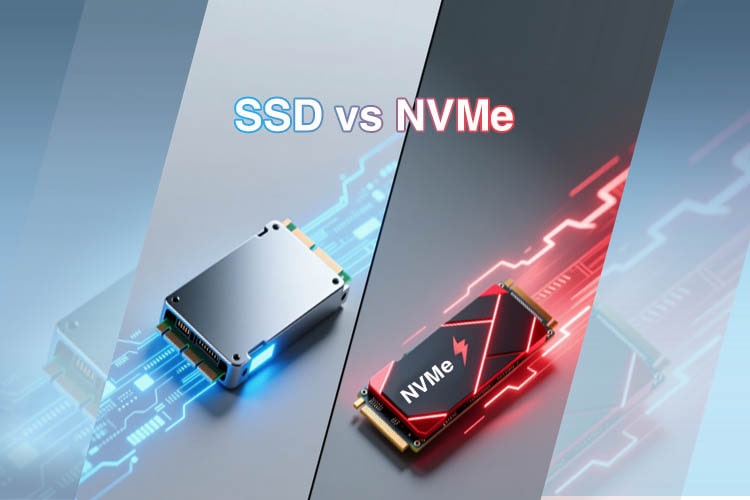
What Is an SSD?
A Solid-State Drive (SSD) is a high-performance storage device that uses flash memory to store data persistently, without any moving mechanical parts. Unlike traditional Hard Disk Drives (HDDs), which rely on spinning disks and read/write heads, SSDs deliver significantly faster data access, lower latency, and improved reliability—making them essential for modern web hosting environments.
In the context of web hosting, SSD storage directly impacts how quickly your website loads, how efficiently databases respond, and how reliably your content is delivered under traffic spikes. Websites hosted on SSD-powered servers typically experience faster page rendering, reduced Time to First Byte (TTFB), and better overall user experience—key factors that influence both visitor retention and search engine rankings.
SSDs are now standard in most professional hosting plans because they align with core performance expectations: stability, speed, and durability. They consume less power, generate less heat, and are more resistant to physical shock, which contributes to higher server uptime and consistent performance—critical for business websites, e-commerce platforms, and content-heavy applications built on systems like WordPress.
While SSDs represent a major leap over HDDs, they are distinct from newer technologies like NVMe (Non-Volatile Memory Express), which further accelerates data transfer by leveraging PCIe lanes instead of the older SATA interface. Understanding these differences helps you make informed decisions when evaluating hosting infrastructure—especially as you scale beyond basic shared hosting into VPS or dedicated environments.
For most users, SSD-based hosting offers the optimal balance of cost, performance, and reliability—forming the foundation of a trustworthy digital presence.
What Is NVMe?
NVMe (Non-Volatile Memory Express) is a high-speed storage protocol designed specifically for solid-state drives that use flash memory. Unlike traditional SSDs that rely on the SATA interface—a legacy standard originally built for mechanical hard drives—NVMe leverages the PCIe (Peripheral Component Interconnect Express) bus to communicate directly with the CPU, dramatically reducing latency and increasing data throughput.
In web hosting environments, this translates to significantly faster read/write operations, lower input/output delays, and superior performance under heavy concurrent workloads. For dynamic websites—especially those built on platforms like WordPress or e-commerce systems—NVMe storage accelerates database queries, page rendering, and media delivery, directly improving user experience and server responsiveness.
NVMe’s architecture supports thousands of parallel command queues, enabling it to handle tens of thousands of I/O operations per second—far exceeding SATA-based SSDs. This makes it ideal for resource-intensive applications, high-traffic sites, or any hosting scenario where consistent low-latency access to data is critical.
While NVMe represents the current pinnacle of storage performance in hosting infrastructure, its benefits are most noticeable in environments that demand real-time data processing. For users evaluating hosting options, understanding whether their workload justifies NVMe versus standard SSD is key to balancing performance and cost-effectiveness—especially when planning for scalability on a VPS or dedicated setup.
How SSD and NVMe Storage Work Differently
While both SSDs and NVMe drives use NAND flash memory to store data without moving parts, they differ fundamentally in how they connect to the system and transfer data—impacting speed, latency, and overall performance in web hosting environments.
Traditional SSDs typically use the SATA (Serial ATA) interface, a legacy standard originally designed for mechanical hard drives. SATA III, the most common version in hosting, caps data transfer speeds at around 600 MB/s. Although this is a vast improvement over HDDs, it creates a bottleneck when handling high volumes of concurrent requests—common in database-driven websites or content management systems.
NVMe, on the other hand, bypasses the SATA interface entirely. Instead, it connects directly to the motherboard via PCIe (Peripheral Component Interconnect Express) lanes, allowing for much higher bandwidth and parallelism. Modern NVMe drives can achieve sequential read speeds exceeding 3,500 MB/s—and even more with newer PCIe generations. More importantly, NVMe supports tens of thousands of command queues with up to 64,000 commands per queue, enabling vastly superior IOPS (Input/Output Operations Per Second) compared to SATA SSDs, which are limited to a single queue with just 32 commands.
In practical hosting terms, this architectural difference means NVMe drastically reduces latency during disk operations. When a visitor loads a dynamic webpage, the server must fetch files, query databases, and assemble content—all of which rely on storage speed. With NVMe, these tasks complete faster, leading to lower Time to First Byte (TTFB), quicker page loads, and better resilience under traffic spikes.
However, the performance advantage of NVMe is most impactful in I/O-intensive scenarios. For static sites or low-traffic blogs, a quality SATA SSD may suffice. But for e-commerce platforms, high-traffic WordPress sites, or applications requiring real-time data access, the efficiency of NVMe’s direct CPU communication pathway becomes a critical infrastructure advantage.
Speed Comparison: SSD vs NVMe Performance Benchmarks
When evaluating storage performance for web hosting, real-world benchmarks reveal significant differences between SATA-based SSDs and NVMe drives—particularly in throughput, IOPS (Input/Output Operations Per Second), and latency.
Standard SATA SSDs, constrained by the SATA III interface, typically deliver sequential read/write speeds of 500–600 MB/s. Their random read/write performance usually ranges between 50,000 to 100,000 IOPS, depending on the controller and NAND quality. While this is sufficient for basic websites and low-to-moderate traffic applications, it becomes a limiting factor under heavy concurrent database queries or during traffic surges.
In contrast, consumer-grade NVMe drives commonly achieve sequential read speeds of 2,000–3,500 MB/s, with high-end datacenter models exceeding 7,000 MB/s using PCIe 4.0 or newer interfaces. More critically, NVMe excels in random I/O performance—often delivering 400,000 to over 1 million IOPS. This is due to its ability to process thousands of parallel command queues directly through the PCIe bus, minimizing CPU overhead and eliminating SATA’s protocol bottlenecks.
Latency further highlights the gap: SATA SSDs typically exhibit access latencies of 0.1–0.3 milliseconds, while NVMe drives operate in the range of 0.02–0.05 milliseconds. In a hosting context, this translates to faster database responses, quicker static file delivery, and reduced server load during peak usage.
For example, a WordPress site loading a complex page might require dozens of small disk reads. On an NVMe system, these operations complete nearly instantaneously, whereas a SATA SSD may introduce measurable delays that accumulate across multiple requests. Over time, this affects not only user experience but also core web vitals like Largest Contentful Paint (LCP) and Time to Interactive (TTI)—factors that influence both bounce rates and SEO rankings.
While raw speed isn’t the sole determinant of hosting quality, performance benchmarks clearly position NVMe as the superior choice for I/O-intensive workloads, high-traffic environments, and applications where responsiveness directly impacts business outcomes.
Latency and IOPS: Why NVMe Delivers Faster Response Times
Latency and IOPS (Input/Output Operations Per Second) are critical performance indicators in web hosting, directly influencing how quickly a server responds to user requests. NVMe technology significantly outperforms traditional SATA SSDs in both metrics, resulting in faster, more responsive websites.
Latency refers to the time delay between a data request and its fulfillment. SATA SSDs, bound by the older AHCI (Advanced Host Controller Interface) protocol, typically exhibit latencies of 100–300 microseconds. NVMe, designed from the ground up for flash storage, leverages a streamlined command set and direct PCIe connectivity to achieve latencies as low as 10–50 microseconds—often five to ten times faster.
This reduction in latency is especially impactful during high-concurrency scenarios. When multiple users simultaneously access a database-driven site—such as an e-commerce store during a sale—each query must be processed with minimal delay. Lower latency means the server can handle more requests in less time, reducing queue buildup and improving perceived speed.
IOPS further illustrates NVMe’s advantage. While a high-end SATA SSD might deliver 90,000–100,000 random IOPS, enterprise-grade NVMe drives routinely exceed 500,000 to 1 million IOPS. This capability stems from NVMe’s ability to support up to 65,535 command queues, each capable of handling 65,536 commands—compared to SATA’s single queue with just 32 commands. The result is vastly superior parallelism and throughput under real-world workloads.
In practical terms, this translates to faster page assembly, quicker API responses, and smoother content delivery—especially for dynamic applications that rely heavily on disk I/O. For instance, loading a WordPress dashboard or processing checkout transactions becomes noticeably snappier on NVMe-backed infrastructure.
For hosting providers and website owners alike, prioritizing low-latency, high-IOPS storage isn’t just about technical superiority—it’s about delivering a reliable, high-performance user experience that supports business goals, retention, and search engine visibility.
Use Cases: When to Choose SSD Over NVMe (and Vice Versa)
Selecting between SSD and NVMe storage should be guided by workload demands, performance requirements, and cost efficiency—not just raw speed. Each technology serves distinct hosting scenarios where its strengths align with real-world needs.
SATA-based SSDs remain an excellent choice for entry-level websites, personal blogs, small business landing pages, or development environments with modest traffic. These workloads typically involve light database usage and minimal concurrent requests, where the 500–600 MB/s throughput of SSDs is more than sufficient. For users prioritizing budget-conscious reliability over peak performance, SSD hosting delivers strong value without unnecessary overhead.
NVMe becomes essential when responsiveness, scalability, and I/O intensity are critical. High-traffic WordPress sites, e-commerce platforms during flash sales, SaaS applications, real-time analytics dashboards, and databases with frequent read/write operations all benefit from NVMe’s ultra-low latency and high IOPS. In these cases, faster data access directly translates to improved user experience, reduced server load, and better handling of traffic spikes.
Content-heavy sites using dynamic caching, media libraries, or CDNs may not see dramatic gains from NVMe if most assets are served from memory or external networks. Conversely, applications relying on frequent disk-based session storage, logging, or transaction processing will experience measurable improvements with NVMe infrastructure.
For developers running resource-intensive staging environments or agencies managing multiple client sites on a single VPS, NVMe ensures consistent performance across containers or virtualized instances. Similarly, businesses planning for future growth may opt for NVMe early to avoid migration complexity later.
In summary: choose SSD for cost-effective, stable performance on low-to-moderate workloads; choose NVMe when speed, concurrency, and low-latency I/O directly impact application performance or business outcomes. The decision isn’t about which is “better” universally—but which is better suited to your specific use case.
Impact on Website Loading Speed and User Experience
Storage technology directly influences website loading speed, which in turn shapes user experience, engagement, and conversion rates. While many factors affect performance—such as code efficiency, caching, and network delivery—the underlying storage layer plays a foundational role in how quickly content is retrieved and served.
When a visitor requests a webpage, the server must access files, query databases, and assemble dynamic content—all of which rely on disk I/O. SATA SSDs reduce this retrieval time significantly compared to traditional HDDs, but NVMe takes it further by slashing latency and accelerating concurrent data access. This difference becomes especially noticeable on database-driven sites like WordPress, WooCommerce stores, or custom web applications where dozens of small read operations occur per page load.
Faster storage translates to lower Time to First Byte (TTFB), a key metric that search engines use to assess server responsiveness. A site hosted on NVMe can often achieve TTFB under 100 milliseconds, while one on SATA SSD may hover around 200–400 ms—delays users perceive as sluggishness, even if brief. Studies show that every 100-millisecond increase in load time can reduce conversions by up to 7%, highlighting the business impact of infrastructure choices.
Beyond initial load, storage speed affects interactive elements: form submissions, AJAX requests, admin dashboard responsiveness, and real-time updates. NVMe’s high IOPS ensures these operations remain smooth even under traffic surges, preventing bottlenecks that degrade user experience during peak usage.
Moreover, consistent performance builds trust. Visitors are more likely to stay, explore, and transact on sites that feel fast and reliable. Search engines reinforce this by favoring pages with strong Core Web Vitals—metrics heavily influenced by backend response times rooted in storage performance.
While frontend optimizations matter, they cannot fully compensate for slow disk I/O. Choosing the right storage tier—SSD for basic needs, NVMe for performance-critical applications—is a strategic decision that directly shapes how users perceive and interact with your digital presence.
Cost Considerations: Is NVMe Worth the Investment?
NVMe storage typically commands a higher price than SATA SSDs due to its advanced architecture, superior performance, and more complex controller design. However, whether it represents a worthwhile investment depends on aligning cost with actual performance needs and business impact.
For small websites, personal portfolios, or low-traffic informational pages, the performance gains of NVMe may not translate into measurable user or business benefits. In these cases, SATA SSD hosting offers excellent reliability and speed at a lower cost, making it a prudent and economical choice.
Conversely, for high-traffic e-commerce stores, SaaS platforms, media-rich applications, or any site where user retention and conversion rates are tied to responsiveness, NVMe’s advantages can justify its premium. Faster page loads reduce bounce rates, improve Core Web Vitals, and enhance server efficiency—potentially lowering long-term operational costs by handling more requests per second with fewer resources.
It’s also important to consider scalability. As traffic grows, infrastructure that once sufficed may become a bottleneck. Investing in NVMe early can delay or eliminate the need for costly migrations or vertical scaling later. For agencies managing multiple client sites or developers running intensive staging environments, the cumulative benefit of reduced latency across workloads often outweighs the initial cost difference.
That said, NVMe should not be viewed as a universal upgrade. If your application is CPU-bound, network-limited, or heavily cached, storage speed may not be the limiting factor. A thorough assessment of your current bottlenecks—using tools like server response time analysis or I/O profiling—is essential before committing to higher-tier storage.
In essence, NVMe is worth the investment when performance directly influences user experience, revenue, or operational efficiency. For others, a well-optimized SSD-based solution remains a smart, cost-effective foundation. The key is matching infrastructure capability to real-world demand—not chasing specifications for their own sake.
Which Storage Type Does Madar Host Use in Its Hosting Plans?
Madar Host deploys storage technology aligned with the performance needs of each hosting tier, ensuring optimal balance between speed, reliability, and value. All hosting plans—across shared, WordPress, VPS, and dedicated server offerings—are built on solid-state drives (SSDs) as the baseline standard, eliminating mechanical bottlenecks and delivering consistent, fast data access.
For entry-level and mid-tier plans, including shared hosting and managed WordPress solutions, Madar Host utilizes enterprise-grade SATA SSDs. These drives provide significant performance improvements over traditional hard drives, supporting rapid page loads, efficient database queries, and stable operation under typical workloads—ideal for small businesses, blogs, and growing websites.
In higher-performance tiers, such as premium VPS and managed dedicated servers, Madar Host integrates NVMe storage where infrastructure demands justify it. These plans are designed for resource-intensive applications, high-traffic e-commerce platforms, and developers requiring ultra-low latency and maximum IOPS. By leveraging NVMe’s PCIe-based architecture, these environments achieve faster data throughput and superior responsiveness during peak usage.
The choice of storage type is not applied uniformly but is strategically matched to the expected workload of each service tier. This approach ensures customers receive appropriate performance without unnecessary cost inflation for use cases that don’t require cutting-edge I/O capabilities.
Across all plans, storage systems are monitored for health, backed by RAID protection where applicable, and maintained with proactive firmware updates to uphold data integrity and uptime. This layered focus on both hardware quality and operational discipline reflects Madar Host’s commitment to delivering dependable, high-performance hosting grounded in real-world engineering—not marketing claims.
Frequently Asked Questions (FAQ)
What’s the main difference between SSD and NVMe?
SSD (Solid State Drive) refers to a type of storage device that uses flash memory, while NVMe (Non-Volatile Memory Express) is a high-speed communication protocol designed specifically for SSDs connected via PCIe. In short, all NVMe drives are SSDs, but not all SSDs use NVMe—they may use the older SATA interface instead.
Is NVMe faster than SATA SSD?
Yes, NVMe is significantly faster than SATA SSDs. While SATA SSDs max out at around 600 MB/s due to interface limitations, NVMe drives can reach speeds of 3,500 MB/s or more on PCIe 3.0—and even higher with PCIe 4.0 or 5.0—making them ideal for performance-sensitive applications like high-traffic websites or databases.
Does NVMe improve website loading speed?
Absolutely. NVMe reduces data access latency and increases IOPS (Input/Output Operations Per Second), which translates to faster page loads, quicker database queries, and smoother user experiences—especially during traffic spikes or when serving dynamic content.
Should I choose NVMe hosting for my WordPress site?
If your WordPress site relies on fast performance—such as an e-commerce store, membership site, or media-rich blog—NVMe hosting offers noticeable improvements in speed and responsiveness. For basic blogs with low traffic, a quality SSD plan may suffice and be more cost-effective.
Are NVMe drives more reliable than SSDs?
Both NVMe and SATA SSDs offer similar reliability since they use the same NAND flash memory technology. However, NVMe’s efficient architecture can reduce wear over time by handling data more intelligently, potentially extending drive lifespan under heavy workloads.
Why is NVMe hosting more expensive than SSD hosting?
NVMe hosting costs more because it uses advanced PCIe interfaces, premium controllers, and higher-performance hardware. The infrastructure investment is greater, but for businesses prioritizing speed and scalability, the performance gain often justifies the price.
Can I upgrade from SSD to NVMe hosting later?
Yes, most hosting providers—including Madar Host—allow seamless upgrades from SSD to NVMe plans. Just ensure your site files and databases are backed up before migrating, though many providers handle the transition automatically with minimal downtime.
Does NVMe affect SEO or Google rankings?
Indirectly, yes. Google considers page speed a ranking factor, and NVMe’s faster load times contribute to better Core Web Vitals scores. While switching to NVMe alone won’t guarantee top rankings, it supports overall site performance—a key element in modern SEO strategy.
Is NVMe necessary for small business websites?
Not always. Small business sites with moderate traffic may perform well on SSD hosting. However, if you anticipate growth, run resource-intensive plugins, or prioritize user experience, investing in NVMe early can future-proof your site and prevent performance bottlenecks.
Do all servers support NVMe storage?
No. NVMe requires compatible motherboard chipsets and PCIe slots. Most modern dedicated and cloud servers support NVMe, but older infrastructure may only accommodate SATA SSDs. Always verify your hosting provider’s hardware specifications before choosing a plan.