VPS vs Cloud Hosting: Key Differences, Use Cas es and Which One Is Right for You
Print- 0
VPS vs Cloud Hosting: Key Differences, Use Cas es, and Which One Is Right for You
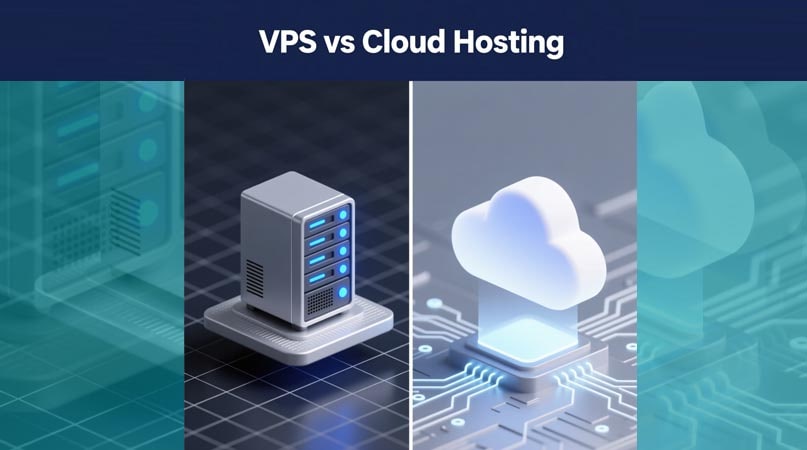
What Is VPS Hosting?
VPS (Virtual Private Server) hosting is a type of web hosting where a physical server is partitioned into multiple isolated virtual environments using virtualization technology. Each VPS operates independently with dedicated allocations of CPU, RAM, storage, and bandwidth—resources that are not shared with other users on the same physical machine.
Unlike shared hosting—where performance can fluctuate due to neighboring sites consuming excessive resources—VPS hosting provides consistent performance and greater control. This makes it ideal for growing websites, e-commerce platforms, and applications requiring stable resource availability and enhanced security.
Each VPS functions like a standalone server, granting users root access to install custom software, configure server settings, and optimize the environment based on specific project needs. This level of autonomy is particularly valuable for developers and businesses running resource-intensive or specialized applications.
VPS solutions come in two primary forms: managed and unmanaged. Managed VPS includes technical oversight from the hosting provider—covering updates, security patches, backups, and monitoring—making it suitable for users without deep server administration experience. Unmanaged VPS places full responsibility on the user but offers maximum flexibility for advanced configurations.
Performance in VPS hosting is further influenced by underlying infrastructure, such as SSD or NVMe storage, network quality, and virtualization efficiency. Choosing a provider that leverages modern hardware and robust architecture ensures optimal speed and reliability.
VPS hosting bridges the gap between affordability and power, offering a scalable middle ground between shared hosting and dedicated servers. It’s especially recommended when your site outgrows shared resources but doesn’t yet require an entire physical server.
For a clear comparison of hosting types and their suitability based on your project stage, refer to our guide on types of web hosting and their differences.
What Is Cloud Hosting?
Cloud hosting is a modern web hosting solution that leverages a network of interconnected virtual and physical servers distributed across multiple locations. Instead of relying on a single physical server—as in traditional VPS or dedicated hosting—cloud hosting dynamically allocates resources from a scalable pool, ensuring high availability, redundancy, and on-demand performance.
This architecture eliminates single points of failure: if one node experiences issues, traffic is automatically rerouted to healthy servers without service interruption. This makes cloud hosting inherently more resilient than conventional setups, especially during traffic spikes or hardware failures.
Resources such as CPU, RAM, and storage are provisioned in real time based on actual demand, allowing for true scalability. Users typically pay only for the resources they consume, following a flexible utility-based pricing model—ideal for websites with variable or unpredictable traffic patterns.
Cloud hosting is particularly well-suited for e-commerce platforms, SaaS applications, media-rich sites, and any project requiring consistent uptime and rapid scaling. Unlike VPS hosting—which offers isolated resources on a single host—cloud environments distribute workloads intelligently across a cluster, enhancing both performance and fault tolerance.
Security in cloud hosting is multi-layered, often including distributed firewalls, DDoS mitigation, and isolated tenant environments. When properly configured, it meets enterprise-grade reliability standards while maintaining operational efficiency.
For businesses evaluating infrastructure options, understanding how cloud hosting differs from VPS or dedicated solutions is essential. A detailed comparison can help align technical requirements with business goals—see our guide on VPS vs Cloud Hosting: Which is right for your website?
Performance: VPS vs Cloud Hosting
Performance in web hosting is determined by resource allocation, architecture design, and how efficiently a system handles traffic spikes and concurrent requests. When comparing VPS and cloud hosting, both can deliver strong performance—but through fundamentally different approaches.
VPS hosting provides dedicated resources (CPU, RAM, storage) on a single physical server. This ensures consistent performance under normal load, as your environment is isolated from other users. However, because it relies on one physical machine, performance may plateau during unexpected traffic surges or hardware limitations.
Cloud hosting, by contrast, distributes workloads across a cluster of interconnected servers. Resources are drawn dynamically from a shared pool, allowing near-instant scaling during traffic peaks. This architecture minimizes bottlenecks and maintains responsiveness even under heavy or unpredictable loads—making it inherently more resilient for performance-critical applications.
Real-world performance also depends on underlying infrastructure. A VPS powered by NVMe storage and modern CPUs can outperform a poorly configured cloud instance, just as a well-optimized cloud setup can surpass a basic VPS. Storage type (SSD vs NVMe), network quality, and server location further influence actual user experience.
For stable, predictable workloads—such as business websites or moderate-traffic e-commerce stores—VPS often delivers excellent and cost-efficient performance. For dynamic, high-traffic, or mission-critical applications like SaaS platforms or media-rich sites, cloud hosting typically offers superior performance consistency due to its elastic nature and redundancy.
To understand how storage technology impacts speed, see our detailed comparison of SSD versus NVMe in hosting environments.
Scalability Comparison – Which Scales Better?
Scalability refers to a hosting environment’s ability to accommodate growth—whether sudden traffic spikes, increased data processing, or expanding application complexity—without performance degradation or service interruption. In this regard, VPS and cloud hosting differ fundamentally in architecture and flexibility.
VPS hosting offers vertical scalability: you can upgrade allocated CPU, RAM, or storage within the limits of the physical server it resides on. These upgrades are typically manual and may require brief reboots, but they provide predictable performance gains. This model works well for steady, linear growth and is ideal when resource needs are known in advance.
Cloud hosting, by contrast, delivers both vertical and horizontal scalability. Resources can be added instantly (vertical), and workloads can be distributed across multiple nodes (horizontal). This elasticity allows cloud environments to handle unpredictable surges—such as flash sales or viral content—without downtime. Scaling often happens automatically based on real-time demand, ensuring consistent performance under variable loads.
For projects with stable growth trajectories—like business websites or moderate-traffic e-commerce stores—VPS provides sufficient and cost-effective scalability. However, for dynamic applications, seasonal traffic patterns, or platforms expecting rapid expansion, cloud hosting’s adaptive infrastructure offers superior resilience and responsiveness.
When planning long-term growth, consider not just current needs but also how easily your infrastructure can evolve. A detailed guide on evaluating your site’s readiness for scaling can be found in our article on how to choose the best hosting for your website.
Reliability and Uptime: How Do They Stack Up?
Reliability and uptime are critical metrics for any hosting solution, directly impacting user experience, SEO performance, and business continuity. VPS and cloud hosting approach these factors through distinct architectural models.
VPS hosting relies on a single physical server. While it offers strong isolation from other users—reducing the risk of “noisy neighbor” issues—its reliability is inherently tied to the health of that one machine. Hardware failure, even with redundant components, can lead to downtime unless rapid failover systems are in place. Reputable providers mitigate this with high-quality hardware, proactive monitoring, and backup power/network infrastructure, typically guaranteeing 99.9% uptime.
Cloud hosting, by design, distributes data and workloads across multiple servers in a cluster or across geographically dispersed data centers. If one node fails, traffic is seamlessly rerouted to operational nodes without service interruption. This redundancy significantly enhances fault tolerance and often results in higher real-world uptime—frequently exceeding 99.95%. The distributed nature also protects against localized outages, making cloud environments more resilient for mission-critical applications.
For businesses where every second of downtime translates to lost revenue or credibility, cloud hosting generally provides a more robust reliability profile. However, a well-maintained VPS on enterprise-grade infrastructure can still meet the uptime needs of most small to mid-sized websites.
Pricing Models – Predictable Costs vs Pay-as-You-Go
Pricing structure plays a pivotal role in long-term budgeting and cost efficiency. VPS hosting typically follows a fixed monthly or annual billing model. You pay a set fee for predefined resources (e.g., 4 GB RAM, 2 CPU cores, 80 GB SSD), regardless of actual usage. This predictability simplifies financial planning and is advantageous for stable workloads with consistent resource demands.
Cloud hosting, in contrast, usually employs a consumption-based or pay-as-you-go model. You’re billed only for the compute, storage, and bandwidth you actually use—often calculated hourly or daily. This offers cost flexibility for variable workloads but can lead to unpredictable invoices during traffic spikes or inefficient configurations. Some providers offer reserved instances or tiered plans to blend predictability with scalability.
Organizations with steady traffic and clear resource requirements often benefit from VPS’s transparent pricing. Those with fluctuating demand, development/testing environments, or seasonal peaks may find greater value in cloud hosting’s granular billing—provided they actively monitor and optimize usage.
Security Features in VPS and Cloud Environments
Security in hosting environments hinges on isolation, access control, infrastructure hardening, and proactive threat management. Both VPS and cloud hosting offer strong security foundations—but their approaches differ due to architectural design.
VPS hosting provides a high degree of isolation through virtualization. Each virtual server operates in its own sandboxed environment with dedicated resources, separate operating system instances, and root-level access. This minimizes the risk of cross-contamination from other users on the same physical host—a common concern in shared hosting. Administrators can implement custom firewalls, intrusion detection systems, and kernel-level security modules (like SELinux or AppArmor) to harden the server according to specific compliance or operational needs.
Cloud hosting environments also enforce tenant isolation, but at a more distributed level. Data and processes are spread across multiple nodes, often with additional layers such as software-defined networking (SDN), encrypted inter-node communication, and hypervisor-level protections. Leading cloud platforms integrate automated DDoS mitigation, distributed firewalls, and real-time security monitoring across the entire infrastructure. Many also support end-to-end encryption for data at rest and in transit, along with identity and access management (IAM) controls for granular user permissions.
However, the shared responsibility model in cloud hosting means that while the provider secures the underlying infrastructure, the user remains responsible for securing the operating system, applications, and data. In contrast, a VPS—especially unmanaged—places full security responsibility on the user, offering greater control but requiring deeper technical expertise.
For regulated industries or applications handling sensitive data, both models can meet stringent security standards when properly configured. The key difference lies in flexibility versus automation: VPS allows for tailored, hands-on security configurations, while cloud environments often provide built-in, scalable security features that reduce manual overhead.
Ultimately, security effectiveness depends less on the hosting type and more on implementation rigor, patch management discipline, and continuous monitoring—regardless of whether the workload runs on a single virtualized server or a distributed cloud cluster.
Who Should Use VPS Hosting?
VPS hosting is best suited for users who have outgrown shared hosting but do not yet require the full resources or cost of a dedicated server. It strikes a strategic balance between performance, control, and affordability—making it ideal for specific use cases and user profiles.
Website owners managing high-traffic blogs, growing e-commerce stores, or business websites with moderate resource demands benefit significantly from VPS hosting. The dedicated allocation of CPU, RAM, and storage ensures consistent performance, even during traffic peaks, without the unpredictability of shared environments.
Developers and technical teams often choose VPS for its root access and full administrative control. This allows custom software installations, tailored server configurations, and fine-tuned security policies—essential for staging environments, custom applications, or legacy systems that require specific runtime dependencies.
Agencies managing multiple client sites also find VPS practical, especially when using control panels like cPanel or Plesk to create isolated accounts. It offers more flexibility than shared reseller hosting while maintaining manageable operational overhead compared to dedicated infrastructure.
Startups and small-to-medium businesses seeking predictable monthly costs and stable performance—without the complexity of auto-scaling or variable billing—often prefer VPS. It provides a clear upgrade path: as needs grow, resources can be increased vertically within the same environment.
However, VPS requires a baseline level of server management knowledge, particularly in unmanaged setups. Users must handle updates, backups, firewall rules, and performance tuning unless they opt for a managed service. Therefore, it’s most appropriate for those with in-house technical skills or willingness to rely on a provider’s managed support.
In summary, VPS hosting is the logical next step for users who need more power and control than shared hosting offers—but still value simplicity, fixed pricing, and a single-server architecture. It’s not designed for highly volatile workloads or enterprises requiring instant horizontal scaling, but for steady, controllable growth with professional-grade reliability.
Who Should Choose Cloud Hosting?
Cloud hosting is engineered for users and organizations that prioritize elasticity, high availability, and resilience over fixed infrastructure. It’s particularly advantageous for workloads with variable or unpredictable resource demands, where performance must remain consistent regardless of traffic fluctuations.
E-commerce platforms experiencing seasonal spikes—such as during holidays or promotional campaigns—benefit greatly from cloud hosting’s ability to scale resources automatically. This ensures uninterrupted service during peak sales periods without over-provisioning during quieter times.
SaaS (Software-as-a-Service) providers, mobile app backends, and API-driven applications also thrive in cloud environments. These services often require 24/7 uptime, rapid response times, and the capacity to handle concurrent user requests across geographies—capabilities inherent to distributed cloud architecture.
Media-rich websites, including video streaming portals, online learning platforms, or digital publishing sites with large image libraries, leverage cloud hosting for its scalable storage and bandwidth. Content delivery can be further optimized when integrated with global CDN networks, reducing latency and improving user experience.
Enterprises and agencies managing mission-critical applications choose cloud hosting for its built-in redundancy. With data replicated across multiple nodes or data centers, the risk of downtime due to hardware failure is significantly reduced—supporting business continuity and compliance requirements.
Development teams engaged in DevOps workflows also favor cloud infrastructure for its agility. Environments can be spun up or torn down on demand, enabling efficient testing, staging, and deployment cycles without long-term commitment to fixed resources.
However, effective use of cloud hosting requires awareness of usage patterns and cost management. While it offers flexibility, unmonitored resource consumption can lead to unexpected billing. Users should either possess cloud optimization skills or partner with a provider offering transparent monitoring and scaling controls.
In essence, cloud hosting is ideal for dynamic, growth-oriented projects where adaptability, fault tolerance, and on-demand performance outweigh the simplicity of a static server setup. It’s not merely about having more power—it’s about having the right resources at the right time, reliably and securely.
Real-World Scenarios: When to Pick VPS or Cloud
Choosing between VPS and cloud hosting becomes clearer when evaluated through real-world use cases that reflect actual business needs, traffic patterns, and technical requirements.
A local e-commerce store selling handmade goods with steady monthly traffic—averaging 10,000 visitors—and predictable sales cycles is well-suited for VPS hosting. It benefits from dedicated resources, consistent performance, and a fixed monthly cost without needing instant scalability. The owner can manage the site via a control panel or rely on managed support, avoiding the complexity of cloud billing and configuration.
In contrast, an online fashion retailer preparing for Black Friday expects traffic to surge from 15,000 to over 200,000 daily visitors within hours. Cloud hosting is the rational choice here: its auto-scaling capabilities absorb the spike seamlessly, while redundant infrastructure ensures uptime during peak demand. Pay-as-you-go pricing also prevents overpayment during off-seasons.
A software development agency running multiple client staging environments prefers VPS for its simplicity and isolation. Each project gets its own virtual server with custom configurations, all under a single predictable invoice. There’s no need for dynamic scaling since these environments are used intermittently and with controlled access.
However, a SaaS startup offering a real-time analytics dashboard to global clients requires high availability and low latency across regions. Cloud hosting provides geographic distribution, automatic failover, and elastic compute power—critical for maintaining service reliability as user count grows unpredictably.
Similarly, a news blog that occasionally goes viral due to breaking stories faces erratic traffic spikes. While a VPS might struggle or require manual intervention during such events, a cloud setup scales automatically, keeping the site accessible without downtime.
For resource-intensive applications like CRM systems or custom databases with stable usage, VPS offers better cost efficiency and direct control over the stack. But for media-heavy platforms—such as video tutorials or podcast hosting—where bandwidth and storage demands fluctuate, cloud infrastructure adapts more efficiently.
Ultimately, the decision hinges on predictability versus variability. If your workload is stable, controlled, and budget-conscious, VPS delivers robust performance. If it’s dynamic, growth-driven, or mission-critical under pressure, cloud hosting provides the resilience and agility needed to succeed.
How Madar Host Optimizes Both VPS and Cloud Solutions
At Madar Host, infrastructure design begins with performance, security, and reliability as non-negotiable foundations. Both VPS and cloud hosting solutions are built on enterprise-grade hardware, featuring NVMe storage, high-frequency CPUs, and redundant networking to ensure low latency and consistent throughput.
VPS environments are provisioned using KVM virtualization—a full hardware virtualization technology that guarantees true resource isolation and near-bare-metal performance. Each virtual server operates independently with dedicated CPU cores, RAM, and I/O bandwidth, eliminating the “noisy neighbor” effect common in container-based systems. This architecture ensures predictable performance for business-critical applications and databases.
For cloud hosting, Madar Host employs a distributed, multi-node cluster with intelligent load balancing and automatic failover. Workloads are dynamically allocated across physical servers based on real-time demand, while data is replicated synchronously to maintain integrity during hardware events. This setup delivers high availability without manual intervention, ideal for applications requiring continuous uptime.
Security is integrated at every layer. Both platforms include network-level DDoS protection, configurable firewalls, and isolated tenant environments. Kernel updates, intrusion detection, and automated backups are standard in managed configurations, reducing operational risk for users without dedicated DevOps teams.
Performance optimization extends to software stack tuning. Web servers, PHP workers, and database engines are pre-configured for efficiency, with optional caching layers (such as Redis or OPcache) available to accelerate dynamic content delivery. All plans support IPv6 and HTTP/3 for future-ready connectivity.
Crucially, Madar Host avoids overselling resources. Whether on VPS or cloud, allocated CPU, RAM, and I/O are guaranteed—not shared or borrowed—ensuring that performance commitments are consistently met under real-world conditions.
This disciplined approach to infrastructure engineering allows Madar Host to deliver scalable, secure, and high-performing hosting solutions tailored to the actual needs of developers, businesses, and digital agencies—without compromising on stability or transparency.
Frequently Asked Questions (FAQ)
What’s the main difference between VPS and cloud hosting?
VPS hosting uses a single physical server partitioned into virtual environments, giving you dedicated resources within that server. Cloud hosting, on the other hand, distributes your website across multiple interconnected servers in a cloud infrastructure, offering greater flexibility and redundancy.
Is cloud hosting faster than VPS?
Cloud hosting can deliver better performance under high traffic or resource spikes because it dynamically allocates resources from a pool of servers. VPS performance is consistent but capped by the allocated resources on a single physical machine.
Which is more cost-effective: VPS or cloud hosting?
VPS typically offers predictable monthly pricing, making it cost-effective for stable workloads. Cloud hosting follows a pay-as-you-go model, which can be cheaper for variable traffic but may lead to higher costs during traffic surges if not monitored.
Can I easily upgrade from VPS to cloud hosting?
Yes, most hosting providers—including Madar Host—allow seamless migration from VPS to cloud hosting. However, the process may require technical adjustments depending on your current setup and applications.
Which hosting type offers better uptime reliability?
Cloud hosting generally provides higher uptime reliability because it automatically shifts workloads to healthy servers if one fails. VPS uptime depends on the health of its single host server, though quality providers still offer strong SLAs.
Is VPS hosting more secure than cloud hosting?
Both can be highly secure when properly configured. VPS offers isolated environments similar to dedicated servers, while cloud hosting relies on advanced network security, firewalls, and distributed architecture. Security largely depends on the provider’s implementation and your own practices.
Who should avoid cloud hosting?
Users with steady, predictable traffic and limited budgets may find VPS more economical and simpler to manage. Those who prefer fixed monthly costs or don’t need instant scalability might not benefit from cloud hosting’s flexible model.
Does cloud hosting include a control panel like VPS?
Yes, many cloud hosting plans—including those from Madar Host—offer intuitive control panels (such as cPanel or custom dashboards) similar to VPS, allowing easy management of files, databases, and domains without command-line expertise.
Can I host multiple websites on VPS or cloud hosting?
Absolutely. Both VPS and cloud hosting support hosting multiple websites. The choice depends on your traffic volume, resource needs, and whether you anticipate sudden growth that would benefit from cloud elasticity.
Which is better for WordPress: VPS or cloud hosting?
For small to medium WordPress sites with stable traffic, VPS is often sufficient and cost-efficient. For high-traffic, e-commerce, or rapidly growing WordPress sites, cloud hosting provides better performance, scalability, and resilience.