VPS vs Dedicated Server: Which Hosting Solutio n Is Right for You?
Print- 0
VPS vs Dedicated Server: Which Hosting Solutio n Is Right for You?
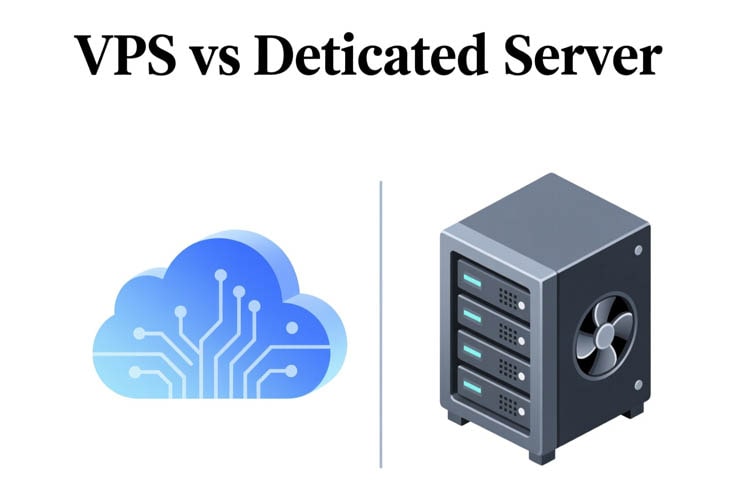
What Is a VPS Server?
A Virtual Private Server (VPS) is a virtualized hosting environment created by partitioning a physical server into multiple isolated virtual machines. Each VPS operates independently with its own dedicated allocation of CPU, RAM, storage, and bandwidth—offering performance and control that far exceed shared hosting, without the cost of a dedicated server.
Unlike shared hosting—where resources are dynamically distributed among dozens or hundreds of websites—a VPS guarantees reserved system resources. This isolation ensures consistent performance, enhanced security, and greater stability, even during traffic spikes on neighboring accounts.
VPS hosting is ideal for growing websites, e-commerce platforms, SaaS applications, and developers requiring root access to customize their server environment. Users can install custom software, configure firewalls, manage databases directly, and fine-tune server settings to match specific application needs.
Two primary VPS models exist: unmanaged, where the user handles all technical administration, and managed, where the hosting provider oversees core maintenance tasks such as security patches, backups, and monitoring. Managed VPS solutions are especially valuable for businesses without in-house DevOps expertise.
Modern VPS environments often leverage SSD or NVMe storage for faster I/O operations, KVM or OpenVZ virtualization for reliability, and scalable architectures that allow seamless resource upgrades—making them a flexible middle ground between shared and dedicated infrastructure.
For those transitioning from shared hosting due to performance limitations or seeking more control without full server management overhead, VPS represents a strategic, cost-effective evolution. Understanding your site’s traffic patterns, technical requirements, and growth trajectory is essential to leveraging VPS effectively.
Learn more about the key differences between shared hosting and VPS to determine if this solution aligns with your current and future needs.
What Is a Dedicated Server?
A dedicated server is a physical hosting machine exclusively allocated to a single client, providing full access to all its hardware resources—CPU, RAM, storage, and bandwidth—without sharing with other users. Unlike shared or virtualized environments, this setup ensures maximum performance, complete isolation, and total administrative control over the server environment.
Dedicated servers are engineered for high-demand applications such as large e-commerce platforms, enterprise systems, data-intensive services, or custom software stacks that require fine-tuned configurations. They offer predictable performance under heavy traffic loads and eliminate the “noisy neighbor” effect common in shared or VPS hosting.
Users benefit from root-level access, enabling deep customization of the operating system, security protocols, network settings, and software stack. This level of control is essential for businesses with compliance requirements, specialized architectures, or advanced security policies.
While dedicated servers deliver superior power and reliability, they also demand greater technical responsibility. Management can be handled in-house (unmanaged) or delegated to the provider through managed services, which typically include monitoring, backups, security hardening, and kernel updates.
Modern dedicated servers often feature enterprise-grade hardware, including NVMe storage for ultra-fast I/O, redundant power supplies, and DDoS protection—making them ideal for mission-critical workloads where uptime and speed are non-negotiable.
For organizations outgrowing VPS capabilities or requiring full infrastructure sovereignty, a dedicated server represents the logical next step in scalable, secure, and high-performance hosting.
Learn more about when to choose between VPS and a dedicated server based on your project’s scale and technical demands.
Key Differences Between VPS and Dedicated Servers
Understanding the core distinctions between VPS (Virtual Private Server) and dedicated servers is essential for aligning your hosting infrastructure with your project’s performance, security, and scalability needs.
Resource Allocation: A VPS partitions a physical server into isolated virtual environments, each with guaranteed—but limited—CPU, RAM, and storage. In contrast, a dedicated server provides exclusive access to all hardware resources of an entire physical machine, eliminating resource contention entirely.
Performance & Isolation: While VPS offers strong performance for most mid-tier applications, it still shares underlying hardware with other virtual instances. Dedicated servers deliver consistent, top-tier performance ideal for high-traffic sites, resource-intensive applications, or real-time data processing, with full physical isolation.
Control & Customization: Both solutions typically offer root access, but dedicated servers allow deeper hardware-level control—such as BIOS configuration, custom RAID setups, and kernel tuning—making them suitable for specialized workloads that demand fine-grained system management.
Scalability: VPS excels in vertical scalability; resources can often be upgraded instantly without migration. Dedicated servers, while powerful, require physical hardware changes for major upgrades, which may involve downtime or planning. However, they offer superior headroom for long-term growth once deployed.
Cost Efficiency: VPS provides a cost-effective balance between shared hosting and dedicated infrastructure, making it ideal for growing businesses. Dedicated servers involve higher operational costs due to exclusive hardware use, justified only when maximum performance and compliance requirements necessitate full server ownership.
Use Case Alignment: Choose VPS for e-commerce stores, SaaS platforms, or WordPress sites needing more power than shared hosting. Opt for a dedicated server when running enterprise applications, large-scale databases, or systems requiring strict regulatory compliance and zero multi-tenancy risk.
For a detailed comparison of hosting types and their ideal scenarios, refer to our guide on types of web hosting and their differences.
Resource Allocation: Shared vs Exclusive
Resource allocation is a fundamental distinction between VPS and dedicated server hosting, directly impacting performance, reliability, and scalability.
In a VPS environment, physical server resources—such as CPU cores, RAM, and storage—are virtually partitioned using hypervisor technology. Each VPS receives a guaranteed, isolated share of these resources. While this ensures consistent performance compared to shared hosting, the underlying hardware is still shared among multiple virtual instances. This model delivers excellent value for websites with moderate traffic or predictable workloads but may face limitations under extreme or sustained peak loads.
Conversely, a dedicated server provides exclusive access to 100% of the physical hardware. All CPU threads, memory modules, and storage capacity are reserved solely for your use. There is no resource contention, no “noisy neighbor” effect, and no dependency on other tenants’ behavior. This exclusivity translates into maximum throughput, minimal latency, and full control over system-level configurations—critical for high-traffic platforms, real-time applications, or compliance-sensitive operations.
From a technical standpoint, VPS resource allocation is dynamic within defined limits (e.g., burstable CPU in some configurations), while dedicated servers offer static, unshared capacity. For database-heavy applications like WooCommerce stores or custom SaaS platforms, this difference can significantly affect query response times and concurrent user handling.
Choosing between shared (virtualized) and exclusive (physical) resources should align with your project’s scale, growth trajectory, and performance requirements. Most growing businesses find VPS sufficient until they consistently saturate allocated resources, at which point a dedicated server becomes a strategic necessity—not just a performance upgrade, but an operational safeguard.
For guidance on evaluating your current resource needs and planning scalable infrastructure, refer to our detailed guide on how to choose the best hosting for your website.
Scalability and Flexibility
Scalability and flexibility are critical factors when evaluating hosting infrastructure, especially as websites evolve from simple blogs to complex digital platforms.
VPS hosting excels in vertical scalability. Resources such as CPU, RAM, and storage can typically be upgraded instantly through the control panel—often without rebooting or migrating data. This on-demand elasticity makes VPS ideal for projects with fluctuating traffic or predictable growth phases, such as seasonal e-commerce stores or SaaS applications in early deployment stages. Additionally, most VPS environments support full root access, allowing users to install custom software stacks, configure firewalls, or optimize server settings to match specific application requirements.
Dedicated servers, while offering unmatched raw power, present a different scalability model. Their strength lies in horizontal expansion and long-term stability. Once deployed, scaling usually involves hardware upgrades—such as adding more RAM modules or replacing drives—which may require scheduled maintenance windows. However, dedicated infrastructure provides the headroom to handle massive, sustained workloads without performance degradation. It also allows for advanced architectural flexibility, including custom RAID configurations, bare-metal virtualization, or hybrid setups combining multiple services on a single machine.
From a flexibility standpoint, both solutions support a wide range of operating systems (Linux distributions, Windows Server), control panels (cPanel, Plesk, DirectAdmin), and automation tools. Yet, dedicated servers offer deeper customization at the firmware and kernel level—essential for enterprises running proprietary applications or requiring strict compliance with security or regulatory standards.
Ultimately, the choice hinges on your growth pattern: if you need rapid, incremental resource adjustments with minimal operational overhead, VPS provides agile responsiveness. If your priority is maximum control, future-proof capacity, and the ability to architect a tailored environment for mission-critical operations, a dedicated server delivers enduring flexibility.
Security Considerations
Security is a decisive factor when choosing between VPS and dedicated server hosting, as each architecture presents distinct risk profiles and protective capabilities.
A VPS environment provides logical isolation through virtualization layers (such as KVM or OpenVZ), ensuring that one user’s processes cannot directly access another’s data. Each virtual instance runs its own operating system with independent root access, firewalls, and security configurations. However, because multiple VPS instances share the same physical hardware and host kernel (in some virtualization models), there remains a minimal—but non-zero—risk of side-channel attacks or hypervisor-level vulnerabilities. For most businesses, this risk is negligible when paired with regular updates, secure configurations, and reputable hosting providers who enforce strict infrastructure hardening.
In contrast, adedicated server offers the highest level of security through complete physical and logical isolation. With no other tenants on the same machine, attack surfaces are significantly reduced. Organizations gain full control over every layer of the stack—from BIOS and firmware settings to network segmentation and intrusion detection systems. This makes dedicated servers the preferred choice for handling sensitive data, financial transactions, healthcare applications, or any workload subject to stringent compliance frameworks like PCI-DSS, HIPAA, or GDPR.
Both hosting types benefit from proactive security measures such as DDoS protection, automated patching, SSH key authentication, and encrypted backups. However, on a dedicated server, these measures can be customized and audited at the hardware level, enabling defense-in-depth strategies that aren’t feasible in shared environments.
It’s also important to note that security responsibility is shared: while the hosting provider secures the underlying infrastructure, the user must harden the operating system, manage access controls, and monitor for anomalies—especially in unmanaged setups. Managed services can alleviate this burden by including proactive threat monitoring, malware scanning, and configuration audits.
For mission-critical applications where data integrity and regulatory compliance are paramount, the exclusive nature of a dedicated server provides unmatched security assurance. For growing websites needing robust—but not enterprise-grade—protection, a well-configured VPS delivers a secure, cost-effective balance.
Technical Management and Control
Technical management and administrative control differ significantly between VPS and dedicated server environments, directly influencing operational responsibility and system customization capabilities.
Both VPS and dedicated servers typically offer root or administrator access, enabling full control over the operating system, installed software, security policies, and network configurations. However, the depth and scope of this control vary. In a VPS, users manage a virtualized instance with predefined hardware parameters—meaning they can configure services like Apache, MySQL, or custom firewalls, but cannot modify the underlying physical layer (e.g., BIOS settings, CPU governor modes, or storage controller firmware).
A dedicated server, by contrast, provides complete bare-metal access. Administrators can fine-tune every aspect of the system—from kernel compilation and RAID array setup to custom bootloader configurations and hardware-level monitoring tools. This level of control is essential for specialized applications such as high-frequency trading platforms, real-time data processing systems, or custom virtualization hosts that require low-level optimizations.
From a management perspective, both solutions are available in managed or unmanaged models. Unmanaged hosting places full responsibility on the user for updates, security patches, backups, and troubleshooting. Managed services, offered by professional providers, include proactive monitoring, automated updates, security hardening, and 24/7 technical support—reducing the operational burden significantly, especially for teams without dedicated DevOps resources.
For developers and IT teams, a VPS offers an agile, sandbox-like environment ideal for testing, staging, or deploying standardized stacks with minimal overhead. Dedicated servers cater to advanced users who need deterministic performance, full auditability, and the ability to implement bespoke infrastructure architectures that align precisely with business or compliance requirements.
Ultimately, the choice depends on your team’s technical capacity and the complexity of your workload. If you require deep system integration and absolute control over the entire stack, a dedicated server is unmatched. If your needs center around application-level flexibility with reduced infrastructure management, a VPS delivers robust control with greater operational simplicity.
Pricing and Cost Efficiency
Pricing and cost efficiency are pivotal considerations when selecting between VPS and dedicated server hosting, as they directly impact long-term budgeting and return on infrastructure investment.
VPS hosting operates on a shared-resource model, allowing providers to distribute the cost of physical hardware across multiple virtual instances. This results in significantly lower entry pricing—typically ranging from a few dollars to moderate monthly fees—making it highly accessible for startups, small businesses, and growing websites. The cost scales incrementally with resource upgrades (e.g., more RAM or CPU cores), offering predictable expenses aligned with actual usage. For projects with variable traffic or evolving technical needs, VPS delivers strong cost-to-performance value without over-provisioning.
Dedicated servers, by contrast, involve exclusive use of an entire physical machine, leading to higher baseline costs. Pricing reflects not only hardware depreciation but also power consumption, bandwidth allocation, and often advanced support tiers. While monthly fees are substantially higher, they provide consistent, high-capacity performance that justifies the expense for data-intensive applications, enterprise platforms, or services requiring guaranteed uptime and compliance adherence. The cost is less flexible in the short term but can be more efficient at scale when measured per transaction, user, or request for high-volume workloads.
It’s important to evaluate total cost of ownership (TCO), not just the base price. A VPS may require more frequent scaling or optimization efforts as traffic grows, potentially increasing management overhead. A dedicated server, while expensive upfront, can consolidate multiple services—such as web, database, email, and backup systems—onto a single machine, reducing licensing and operational complexity.
Additionally, managed vs. unmanaged options influence cost efficiency. Managed VPS plans include technical support and maintenance, adding value for teams without in-house expertise. Similarly, managed dedicated servers offset the need for full-time system administrators, turning capital expenditure into operational expenditure with predictable billing.
In summary, VPS excels in affordability and granular scalability for mid-tier workloads, while dedicated servers offer superior long-term efficiency for high-demand, mission-critical environments where performance and control outweigh initial cost concerns.
Who Should Choose a VPS?
A Virtual Private Server (VPS) is the optimal hosting solution for users who have outgrown shared hosting but do not yet require the full resources or cost commitment of a dedicated server. It strikes a strategic balance between performance, control, and affordability—making it ideal for a specific set of use cases and user profiles.
Growing websites and online stores experiencing consistent traffic increases—such as e-commerce platforms built on WooCommerce, Magento, or custom frameworks—benefit from the guaranteed CPU, RAM, and SSD storage that VPS provides. Unlike shared hosting, where resource spikes from neighboring accounts can degrade performance, VPS ensures stable response times even during sales events or marketing campaigns.
SaaS startups and application owners launching resource-sensitive web applications—such as booking systems, membership portals, or API backends—rely on VPS for predictable infrastructure behavior. The isolation prevents external interference, while scalability enables seamless upgrades as user bases expand.
Businesses with moderate compliance needs also find VPS suitable. While not as tightly controlled as dedicated hardware, a well-configured VPS with private networking, encrypted storage, and hardened firewalls can meet basic regulatory expectations for data handling—especially when paired with managed security services.
Additionally, users who value cost efficiency without sacrificing control</strong—such as freelancers, small IT teams, or bootstrapped ventures—appreciate the ability to scale resources on demand without long-term contracts or upfront hardware investment.
In essence, VPS is best suited for technically aware users or organizations that need more power and autonomy than shared hosting offers, but whose workloads do not yet justify the expense and complexity of a dedicated physical server. It serves as both a practical upgrade path and a scalable foundation for future growth.
Who Needs a Dedicated Server?
A dedicated server is not a one-size-fits-all solution—it’s a strategic infrastructure choice reserved for specific use cases where performance, security, and control are non-negotiable.
High-traffic websites and e-commerce platforms that consistently serve tens of thousands of daily visitors often require the full resource allocation of a dedicated machine. Shared or virtualized environments may struggle with database query loads, concurrent user sessions, or checkout processing during peak sales—scenarios where dedicated hardware ensures uninterrupted service and consistent response times.
Enterprises and SaaS providers running mission-critical applications—such as customer portals, CRM systems, or proprietary software—benefit from the isolation and reliability of a dedicated server. Full root access enables deep integration with internal tools, custom middleware, and compliance-driven configurations that virtual environments cannot fully support.
Organizations with strict regulatory or security requirements—including those in finance, healthcare, or government sectors—often mandate physical server isolation to meet standards like PCI-DSS, HIPAA, or GDPR. A dedicated server eliminates multi-tenancy risks and provides auditable control over data handling, network segmentation, and access logs.
Media-rich platforms and data-intensive services, such as video streaming sites, large-scale analytics dashboards, or backup repositories, demand high I/O throughput and substantial storage capacity. Dedicated servers with NVMe drives, RAID arrays, and redundant networking offer the bandwidth and resilience these workloads require.
Game server hosts, development teams, and DevOps environments also leverage dedicated infrastructure for sandboxing, testing, or hosting multiple isolated services on a single powerful machine. The ability to virtualize internally (e.g., using KVM or Proxmox) while maintaining bare-metal performance adds significant operational flexibility.
It’s important to note that a dedicated server is not merely about raw power—it’s about predictability. When every millisecond of latency impacts user retention or revenue, and when system failures carry high business risk, the investment in exclusive hardware becomes justified.
However, this level of infrastructure is unnecessary for most small to mid-sized websites. Unless your project consistently exhausts VPS resources, requires hardware-level customization, or handles sensitive data at scale, a well-configured VPS remains the more efficient and cost-effective path.
When to Upgrade from VPS to Dedicated Hosting
Upgrading from a VPS to a dedicated server is a strategic decision driven by performance thresholds, operational demands, and business maturity. Key indicators include consistently maxing out allocated CPU or RAM despite optimization, frequent I/O bottlenecks during peak traffic, or the need for hardware-level customization that virtualization cannot support. If your application experiences latency spikes during routine operations—or if you’re managing multiple high-traffic sites on a single VPS—it’s a strong signal that shared physical resources are no longer sufficient. Additionally, businesses handling sensitive data, requiring compliance certifications, or running real-time services (e.g., financial platforms or live analytics) often necessitate the isolation and control only a dedicated server provides.
Madar Host VPS and Dedicated Server Solutions
Madar Host delivers enterprise-grade VPS and dedicated server solutions engineered for performance, reliability, and scalability. Our VPS environments feature SSD/NVMe storage, full root access, and flexible resource allocation, ideal for growing websites and developers. For advanced workloads, our dedicated servers offer bare-metal hardware, customizable configurations, DDoS protection, and optional managed support—ensuring your infrastructure aligns precisely with technical and business requirements. Built on robust network architecture and backed by responsive technical expertise, both solutions prioritize uptime, security, and operational efficiency without exaggerated claims or hidden limitations.
Frequently Asked Questions (FAQ)
What’s the main difference between VPS and dedicated server hosting?
A VPS (Virtual Private Server) partitions a physical server into multiple virtual environments, offering dedicated resources within a shared infrastructure. A dedicated server provides an entire physical machine exclusively to one user, ensuring full control over all hardware resources.
Is a VPS faster than a dedicated server?
No—dedicated servers are generally faster because they offer exclusive access to CPU, RAM, and storage without resource contention. While VPS performance has improved significantly with modern virtualization, it still can’t match the raw power and consistency of a dedicated server under heavy load.
Which is more secure: VPS or dedicated server?
Dedicated servers offer superior security since no other users share the hardware, reducing risks like “noisy neighbors” or cross-tenant vulnerabilities. VPS environments are isolated but still reside on shared physical hardware, which may pose minimal security trade-offs compared to fully dedicated setups.
Can I upgrade from VPS to dedicated hosting easily?
Yes, most hosting providers—including Madar Host—allow seamless migration from VPS to dedicated hosting. The process typically involves data transfer, DNS updates, and configuration adjustments, often supported by technical teams to minimize downtime.
How much does a dedicated server cost compared to VPS?
Dedicated servers cost significantly more than VPS plans due to exclusive hardware usage, higher maintenance, and greater performance capabilities. VPS hosting offers a budget-friendly middle ground between shared and dedicated hosting, ideal for growing websites with moderate traffic.
Do I need technical skills to manage a dedicated server?
Managing a dedicated server usually requires advanced technical knowledge for tasks like OS configuration, security hardening, and performance tuning. However, many providers offer managed dedicated services where the host handles backend administration, making it accessible even to less experienced users.
Is VPS suitable for e-commerce websites?
Yes, a VPS is well-suited for small to medium e-commerce sites that need better performance and security than shared hosting but don’t yet require a full dedicated server. It offers root access, scalable resources, and isolated environments—ideal for running platforms like WooCommerce or Magento.
When should I consider switching to a dedicated server?
Consider upgrading to a dedicated server when your site experiences consistent high traffic, requires strict compliance (e.g., PCI-DSS), needs custom hardware configurations, or suffers performance bottlenecks despite maxing out your VPS resources.
Are backups included with VPS and dedicated servers?
Backup policies vary by provider. At Madar Host, both VPS and dedicated server plans often include optional or automated backup solutions—but it’s essential to verify the specifics of your plan and implement your own backup strategy for critical data.
Can multiple websites run on a single VPS or dedicated server?
Yes, both VPS and dedicated servers support hosting multiple websites. With proper configuration (e.g., using cPanel, Plesk, or manual virtual hosts), you can securely manage several domains, each with its own resources and settings—though dedicated servers offer more headroom for large-scale multi-site operations.